
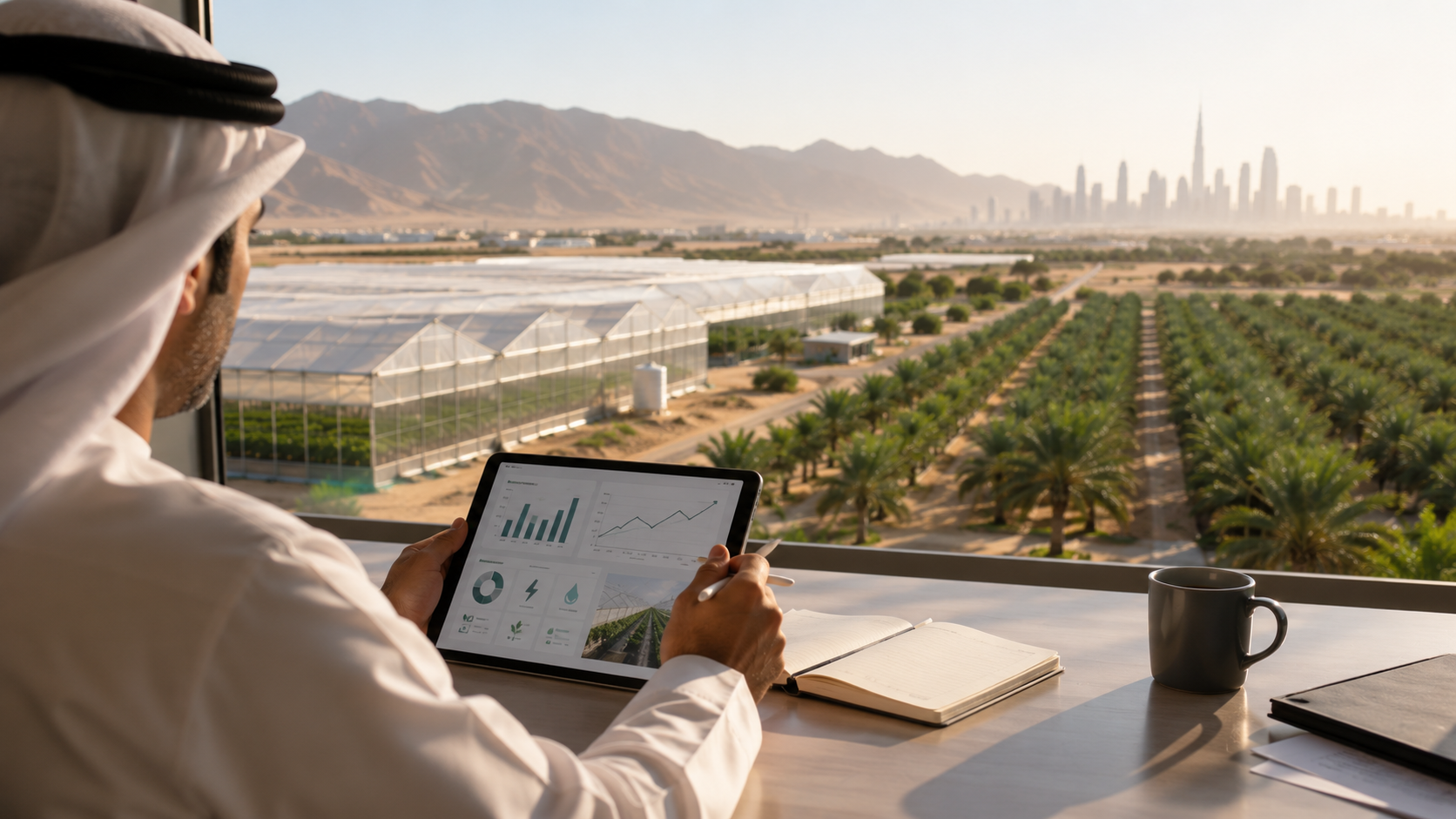
The UAE is one of the world’s most advanced and globally connected agrifood markets. It has exceptional access to international food supply through sophisticated logistics infrastructure, strategic reserves, and global trading relationships. For many long shelf-life products, availability is not the primary challenge. The greater strategic priority lies elsewhere: producing short shelf-life, high-quality food competitively under one of the world’s most demanding production environments.
This distinction fundamentally changes how agricultural technologies should be evaluated.
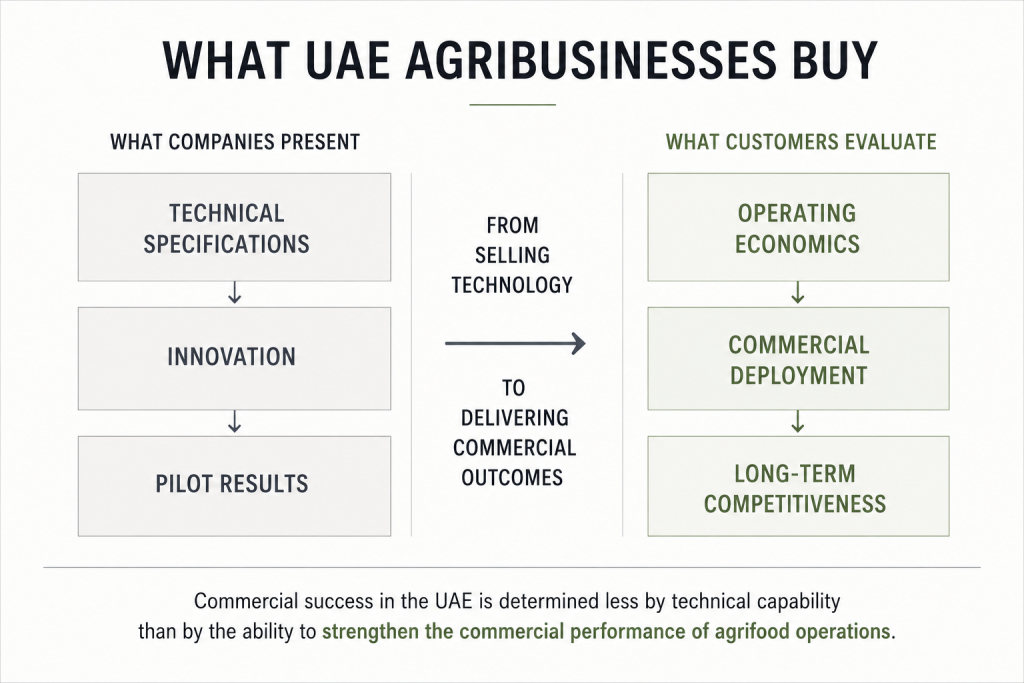
Many international companies approach the UAE believing they are selling innovation. Their presentations focus on artificial intelligence, sensors, automation, biological inputs, irrigation technology, or other technical features. Yet operators, investors, and government stakeholders are asking a different set of questions.
They are not buying technology.
They are buying commercial outcomes.
A technology has value only if it improves the economics of food production under UAE conditions. Lower operating costs, improved resource productivity, reduced commercial risk, and stronger year-round production are ultimately what matter. Technical sophistication alone is rarely enough.
This perspective reflects a broader shift in how food security is being pursued.
Food security remains the strategic objective, but commercial competitiveness has increasingly become the mechanism through which that objective is achieved. Local production must compete against imports from some of the world’s most efficient agricultural regions. Success therefore depends on producing food that is consistently high quality, available throughout the year, and commercially viable—not simply technically possible.
A Framework for Assessing Commercial Fit
At AL DURR, we believe the most important question is not “How innovative is this technology?” but rather “Can this solution deliver measurable commercial value under real operating conditions?”
To answer that question consistently, we evaluate opportunities against six commercial dimensions.
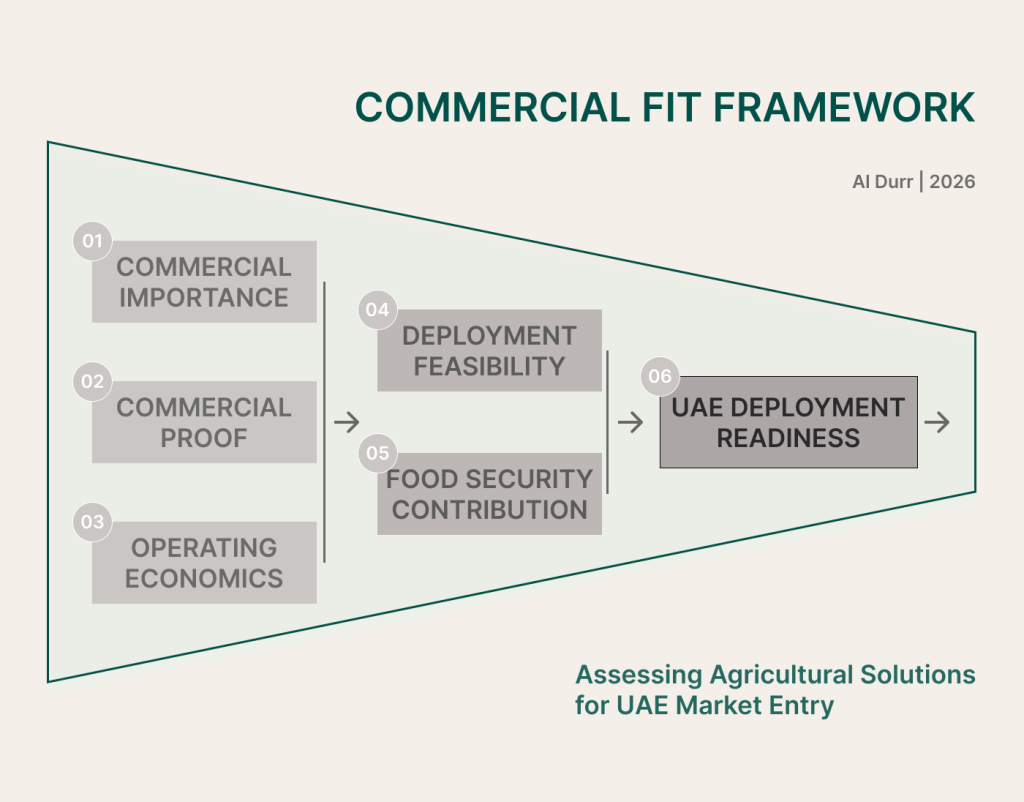
1. Is the problem commercially important?
Every successful technology removes a meaningful commercial constraint, not simply an operational inconvenience. Before evaluating the solution itself, it is essential to determine whether it addresses a bottleneck that materially affects profitability, competitiveness or long-term resilience.
In the UAE, the most valuable technologies typically solve one or more of the following:
- Water productivity
- Energy consumption
- Labour availability
- Production consistency
- Import substitution
- Commercial risk
Key question: If this problem disappeared tomorrow, would the economics of the business materially improve? If the answer is no, the technology is unlikely to justify investment.
2. Has commercial value already been demonstrated?
Pilot projects demonstrate technical possibility. Commercial deployments demonstrate business viability. There is an important difference.
Rather than asking whether a technology works, we ask whether it has already created measurable commercial value under comparable operating conditions.
Evidence should ideally include:
- Multi-year commercial deployments
- Comparable climate conditions
- Independent customer references
- Demonstrated ROI
- Repeatable operational performance
Commercial evidence reduces uncertainty far more effectively than promising pilot results.
3. Does it improve operating economics?
Higher yields do not necessarily create a stronger business. In high-cost production environments such as the UAE, profitability depends on improving unit economics rather than biological performance alone.
Evaluation should therefore extend beyond crop performance.
Key commercial metrics include:
- Production cost
- Water productivity
- Energy productivity
- Labour productivity
- Asset utilisation
- Gross margin
The objective isn’t higher yield. It’s higher return on capital employed.
4. Is deployment commercially and operationally feasible?
Many technically successful solutions fail because implementation proves too difficult or too expensive. Commercial adoption depends as much on operational practicality as technical capability.
Questions we typically ask include:
- Is CAPEX reasonable?
- Can existing teams operate it?
- Does it integrate with current systems?
- How disruptive is implementation?
- How quickly can value be realised?
The best technologies fit naturally into existing operations while improving commercial performance.
5. Does it strengthen UAE food security?
Food security is not achieved simply by producing more food. It is achieved by building commercially resilient production systems that remain competitive over the long term.
Strong solutions typically:
- Increase year-round production
- Improve supply resilience
- Reduce resource intensity
- Support local value creation
- Align with national food security priorities
The strongest investments create commercial value while simultaneously strengthening the national food system.
6. Can commercial success be replicated?
One successful project proves a possibility.
Replicable success creates an industry.
We therefore look beyond a single deployment and assess whether success can be repeated across:
- Multiple farms
- Different operators
- Different crop types
- Different production systems
- Sustainable economics without subsidy
Replicability is often the clearest indicator that a technology has genuine long-term commercial potential.
Moving Beyond Technology
Many companies struggle to enter the GCC because they continue to position themselves as technology providers.
Successful organisations position themselves differently.
They demonstrate precisely which commercial bottleneck they remove, quantify financial benefit, provide evidence from comparable commercial deployments, and clearly explain how their solution strengthens the competitiveness of local food production.
For investors, operators, and policymakers, this shift in thinking is equally valuable. Rather than asking “Is this the most advanced technology?” the more useful questions become:
- Which commercial constraint does this remove?
- How quickly can ROI be achieved?
- Does it improve production economics?
- Can it be deployed reliably under UAE conditions?
- Will it remain commercially sustainable at scale?
These questions produce better investment decisions because they focus on commercial outcomes rather than technical novelty.
In a market as demanding as the UAE, competitive advantage is rarely created by having the newest technology. It is created by consistently improving the commercial performance of agrifood systems. Technologies are simply one component of that equation.
The organisations most likely to succeed are those that understand the distinction—and can demonstrate measurable commercial value before asking the market to adopt their solution.